
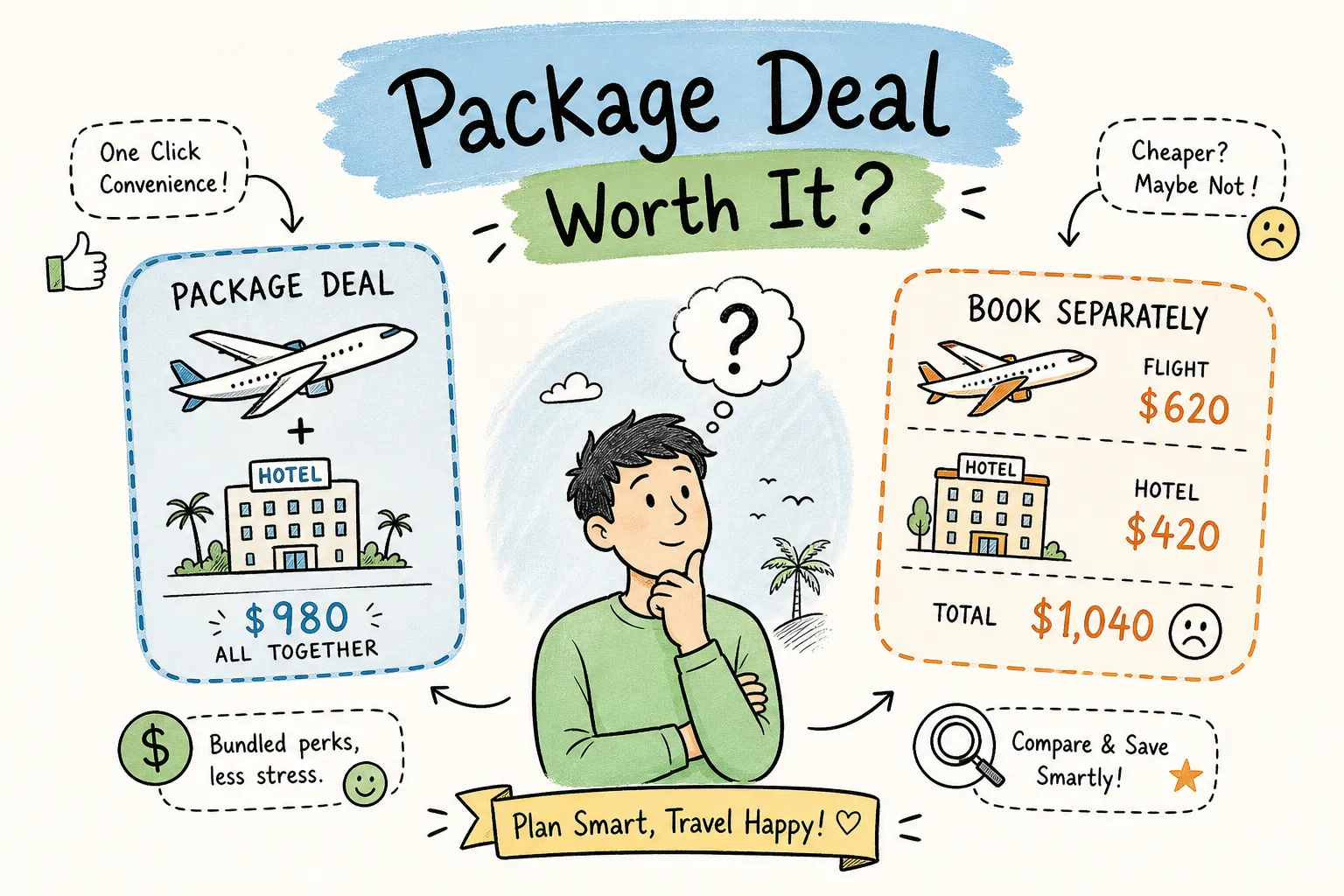

Flight and hotel package deals are everywhere, but do they actually save you money? You’ve seen the banners: “Bundle and save up to 30%!” The math looks good at first glance, and the button is usually a very persuasive shade of green. But a nagging question follows most travelers all the way to the checkout screen: is this genuinely cheaper, or does it just feel cheaper because the number is big? The honest answer is that flight and hotel package deals save money in many situations and cost more in others. This guide gives you the real numbers, the fine print, and a clear method for deciding when a bundled vacation package is worth it, and when you’re better off pricing each piece separately.
Not all packages are built the same way, and that’s the core of the problem. Some bundles stop at a flight and a room, leaving transfers, activities, and mandatory hotel fees as surprises you discover on arrival. Others, like the international tour packages offered by Hama Tourism, price everything into one figure: flights, hotel nights, airport-to-hotel transfers, and curated sightseeing experiences included from the start. The difference between those two models is what determines whether the advertised saving holds up in real life or quietly shrinks to nothing.
How flight and hotel package deals actually save you money (real numbers, not marketing)
The 10% benchmark and where it comes from
Expedia has reported an average saving of around 14% when customers bundle a flight and hotel together versus booking each separately. On a $3,000 itinerary, that works out to roughly $420 back in your pocket. Across the broader industry, analysts and travel publications typically cite a realistic range of 5% to 15%, depending on the destination, the time of year, and which platform you’re using. For planning purposes, 10% is the safest midpoint to use when estimating what you’ll actually save.
The discount exists because large OTAs buy hotel room blocks in bulk and receive discounted wholesale rates. When a customer adds a flight to that hotel booking, the platform passes part of its margin forward as an incentive. The saving is real, but it’s a structural feature of how the platform buys inventory, not a guaranteed outcome every time you search.
When bundling costs you more instead of less
Bundled prices are not always cheaper. Some packages display a standard hotel rack rate alongside a sale airfare, making the combination look like a significant deal when the hotel portion alone is inflated. Before you confirm any vacation bundle, run one quick check: price the flight and the hotel separately on the same dates. If the combined separate total beats the bundle price, skip the bundle. If the bundle wins by a meaningful margin, proceed with confidence.
The travelers who skip that comparison are the ones who pay full hotel rates while assuming they’re getting a discount, simply because the word “bundle” is in the headline. Taking a few extra minutes to verify the numbers can easily be the difference between a real flight hotel package discount and a repackaged price, and on a $2,500 trip, that difference is worth finding.
What most flight and hotel package deals include, and what quietly gets left out
Standard inclusions in a typical airline vacation package
A basic OTA vacation bundle typically covers economy airfare (sometimes with one checked bag, often without), a set number of room-only hotel nights, and an instant booking confirmation. That’s where most advertised vacation bundle deals stop. The itinerary is technically complete, but actually completing the trip involves a list of costs the headline price never mentions.
The hidden costs that shrink your advertised savings
Resort fees alone run $30 to $60 per night at many properties, and they’re charged at check-in regardless of what the OTA’s bundle page said. Add baggage fees if the package used a basic economy fare, departure taxes, local hotel taxes, airport-to-hotel transfers, seat assignment charges, and tips, and a 14% advertised saving on a $3,000 package can shrink considerably once those costs stack up. Think of it as an illustrative check: if fees and extras add up to several hundred dollars, the real net saving could drop from the headline figure to something much closer to 4% or 5%. The advertised number wasn’t wrong, but it also wasn’t describing the full trip.
The fees most likely to surprise travelers are the mandatory ones: resort fees and local hotel taxes that appear only at checkout or at the property itself. These aren’t optional add-ons you can decline. Build them into your comparison from the beginning, or the math you used to justify the bundle won’t match what you actually spend.
The best time to book for the lowest package price
Domestic vs. international timing windows
For domestic travel, the sweet spot for bundled flight-and-hotel pricing falls around four to eight weeks before departure. Google Flights data shows domestic airfare typically reaches its lowest point around 38 days before departure, and packages hit their best combined price when both the flight and hotel components are simultaneously favorable. For international travel, extend that window considerably: start shopping four months out and aim to book by the three-month mark.
The timing difference comes down to how flights and hotels price independently. Airfare often reaches its lowest point earlier, while hotel rates can soften closer to arrival. A package captures its best combined value when those two pricing cycles overlap, which happens sooner for domestic routes and later for international ones.
How peak season and last-minute booking change the equation
The timing windows above apply to standard and off-peak travel. During summer school breaks, major holidays, and popular events, earlier is always better because inventory disappears before prices drop. Waiting for last-minute deals during peak season is a losing strategy for most travelers, not a clever one.
Last-minute packages, booked one to three weeks before departure, can work for highly flexible travelers in off-peak periods when operators need to fill remaining seats and rooms. The savings can be real in those windows, but the selection is limited and the flight times are rarely ideal. If flexibility is your priority and the destination matters more than the details, it’s worth checking. If you have specific hotel preferences or a tight travel schedule, book early.
Cancellation and change policies: what happens when plans shift
The 24-hour window and what follows it
Most major package providers offer a 24-hour free cancellation window for eligible bookings. After that window closes, fees escalate on a tiered schedule that varies by provider. United Vacations, for example, charges $100 per person for changes made four or more days before departure, plus any applicable airline and hotel penalties. JetBlue Vacations charges $100 per person for any cancellation, regardless of timing, and their packages are nonrefundable beyond that fee. Check each provider’s current terms before booking, since cancellation policies can and do change.
The pattern across providers is consistent: the closer you get to departure, the more you lose. Many packages reach 100% nonrefundable status within 21 days of travel, and some promotional rates hit that threshold from the moment of booking. Read the cancellation terms before you enter payment information, not after.
Flexible packages vs. nonrefundable packages: which to choose
Promotional flight and hotel package deals almost always come with the strictest cancellation terms. The lower the price, the less flexibility you retain. A flexible rate costs more upfront but preserves your ability to cancel without losing the entire purchase. If your travel dates are firm and your confidence level is high, the promotional rate makes financial sense. If there’s any meaningful chance your plans could change, the small premium for a flexible rate is worth paying. Losing 100% of a $2,500 package to a single scheduling conflict is a much worse outcome than paying an extra $80 for cancellation protection at booking.
What a truly complete international bundle looks like: Hama Tourism’s model
Beyond flights and hotels: the full-inclusion difference
Most OTA packages stop at the room and the flight, which means the costs that follow, transfers, entrance tickets, and guided experiences, land outside the budget you planned. Hama Tourism’s international packages are structured differently. One price covers flights, hotel accommodations, airport-to-hotel transfers, and curated sightseeing experiences at destinations like Dubai and Bali. The comparison between an OTA bundle and a full-inclusion package is only apples-to-apples when you add the OTA’s missing costs back into the total.
What to look for in a package worth booking
A genuinely competitive vacation bundle has a few clear markers. Inclusions are listed in detail before checkout, not revealed at the property. A clear tax and fee breakdown is visible upfront, not buried in fine print. Cancellation terms match your travel confidence level. And the total price holds up against the separate-booking comparison you ran yourself.
If a package lists all of those elements transparently, with transfers, curated activities, and visa assistance built into the base price, it’s a strong sign the structure is built around real value rather than headline appeal. That’s the difference between a deal that delivers and one that merely looks like one in a search result. Hama Tourism packages are designed around that standard of transparency, so you can evaluate the full cost before you commit rather than after you arrive.
How to compare flight and hotel package deals quickly and accurately
The three-step comparison that protects your budget
Before booking any flight and hotel package deal, run this comparison. First, price the flight and hotel separately on the same dates using the airline’s direct site and the hotel’s own booking page. Second, add your estimated hidden costs to that separate total: resort fees, airport transfers, baggage fees if applicable, and any activities you’d otherwise pay for individually. Third, compare that full number to the package price, including any taxes and fees already built in.
Think of the results as a practical guide rather than a hard rule: if the package comes out meaningfully ahead, say, 8% or more, it’s likely worth booking. If the gap is narrow, separate booking may give you more flexibility for a similar overall cost, and flexibility has real value if anything changes. Present those numbers as your own working estimate rather than a guaranteed threshold, and weigh how much your travel plans depend on schedule certainty. This comparison removes the guesswork from a decision that often involves thousands of dollars.
Airline vacation packages vs. OTA bundles: a quick distinction
Airline vacation packages sold directly through carriers (United Vacations, JetBlue Vacations, and similar programs) sometimes offer flight hotel package discounts that differ from what you’ll find on third-party OTAs. Airline-direct packages tend to have clearer baggage policies and more straightforward change terms, since both components live under one provider’s umbrella. OTA bundles often deliver better hotel selection but can involve multiple providers for changes. Knowing which type you’re buying helps you read the fine print accurately.
The bottom line on vacation package savings
Flight and hotel package deals save money in many situations. The realistic saving for an average traveler, after accounting for the costs that don’t appear in the headline price, typically falls in the range analysts describe as 5% to 15%, with roughly 10% as a reasonable midpoint when the math is done honestly. That’s a meaningful number on a $3,000 trip, and it’s worth pursuing when the package includes what it claims and you’ve verified the comparison.
For international travel where transfers, sightseeing, and visa logistics are part of the equation, full-inclusion packages address the gaps that standard OTA bundles leave open. The OTA bundle gets you to the room. A complete package gets you through the trip. The difference in real cost and real experience shows up in the total you spend rather than the total you’re quoted.
Run the comparison before you book, read the cancellation terms before you pay, and look for packages where the price actually covers the trip. If you’re planning an international trip to Dubai, Bali, Kerala, or Manali, reach out to the Hama Tourism team to see a full breakdown of what’s included and how the total compares to piecing it together on your own.
0 Comment